krumbi.de
Deutsch

Gallery · November 2026

Bunker Museum near Ilmenau

Automatically translated (Gemini). Original in German

Coat of arms of Ilmenau

The Bunker Museum near Ilmenau is a fascinating relic of the Cold War.

History: A 3,600 m² command bunker built in the 1970s (code name “Trachtenfest”) on behalf of the Ministry for State Security (Stasi).

Museum operations: Open as a museum since 2004. On guided tours, visitors experience the original furnishings and gain direct insight into East Germany's recent history.

Special feature: In addition to regular tours, you can even spend the night in the bunker on a “journey through time” featuring an authentic NVA atmosphere.

Coat of arms of Ilmenau: Vectorization: Clemenspool, Public domain · Wikimedia Commons

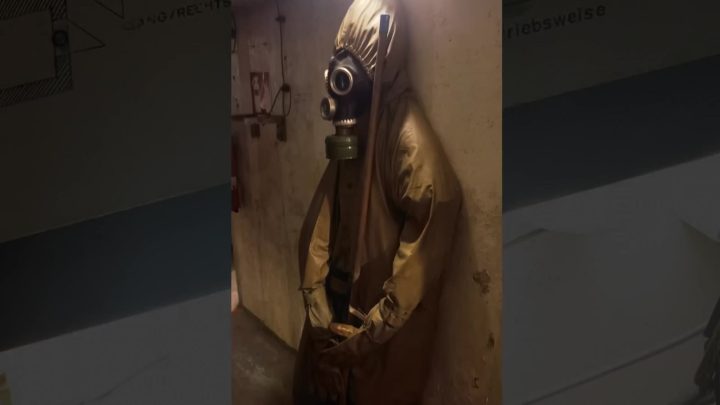
A mannequin in East German protective clothing with a gas mask in a corridor of the former Frauenwald alternate command bunker.Gas masks and containers for decontamination agents at the Frauenwald Bunker Museum, part of the facility's former NBC protective equipment for the MfS.When sweeping the bunker hallway calls for taking absolutely zero risks.A mannequin in East German protective gear with a gas mask and steel helmet sitting on a wooden bench beside a medical cabinet in the Frauenwald Bunker Museum.Indicator panel and communications equipment in the former Stasi alternate command post: the illuminated floor plan displays the functional areas of the 3,600 m² facility.Workstations with rotary-dial telephones, monitors, and cameras in the former MfS command bunker at Frauenwald.A historic issue of “Freies Wort”, the former party organ of the SED district leadership in Suhl, on display in the bunker museum.An East German “Radeberg-74” radio receiver, a rotary phone, and the SED district newspaper “Freies Wort” on a desk in the bunker facility.Original logbook for officers on duty next to an intercom system on a desk in the former command bunker.The indicator panel in the control room displays the schematic layout of the bunker structure, with functional areas ranging from the kitchen to the radio and IT operations center.An inclined-tube manometer on the wall monitored slight positive pressure inside the shelter, flanked by telecommunications equipment.A row of historic teleprinters in the communications wing of the Frauenwald complex, the former alternate command post of the Stasi district administration of Suhl.A row of typewriter workstations in the former Frauenwald Stasi bunker. In an emergency, reports and orders were meant to be transmitted from here.Monitoring station with a control panel for building services and ventilation in the “Trachtenfest” command bunker. Along with indicator lights and switches, a desk clock sits against the wall.Workstations equipped with a mechanical typewriter, rotary telephone, and uniform in the former Stasi alternate command bunker near Frauenwald.Office and break area in the former Stasi bunker: beside an East German radio atop a display case, rotary phones and typewriters sit ready on the desks.Duty office in the former Stasi command bunker near Frauenwald, authentically furnished with a typewriter, telephone, and period furniture.Wall map of the German Democratic Republic on a wall inside the former “Trachtenfest” command bunker.Firmly padlocked and marked with a star on the lid: the contents of these crates remain classified for now.Emergency workstations in the Frauenwald bunker: equipped with a mechanical typewriter, a red duty phone, and early computing hardware.Washroom in the former command bunker: three simple sinks and mirrored cabinets under fluorescent lighting illustrate the planned accommodations in an emergency.Telecommunications center with a switchboard console and rotary-dial phones in the former Stasi alternate command post near Frauenwald.Teleprinters and communications systems in the radio and telecommunications room of the former Stasi command bunker near Frauenwald.Teleprinter equipment and workstations in the subterranean offices of the former Frauenwald alternate command post.Office workstation featuring East German computing equipment from VEB Robotron, including a K 6314 serial printer and a visual display terminal in the former MfS command bunker.East German computer hardware from the Robotron conglomerate at the workstations of the former Frauenwald Stasi command bunker.Workstations with vintage East German computing hardware and monitors in the former MfS command bunker near Frauenwald.Crossbar switch of an electromechanical telephone exchange in the bunker facility. Back then, connections were routed purely mechanically using such crossbar selectors.Relay strips of the telecommunications and switching equipment in the Frauenwald bunker. The facility's internal communications relied on electromechanical contacts like these.Telecommunications technology in the Frauenwald bunker: mechanical counters, test jacks, and miniature fuses for monitoring and switching internal lines.Relay spring sets and numbering of an electromechanical telephone exchange. Robust East German switching technology secured the facility's communications.Workstations in the telecommunications and communications center with original equipment in the former Stasi bunker near Frauenwald.The bunker complex's medical area with an examination couch and washbasin. An autonomous first-aid station was provided in case of emergency.Sleeping comfort by the book: on the narrow metal bunks, the mattresses are still neatly packed.Uniform jacket with the cuff title of the East German Border Troops, a cassette recorder, and personal items in a room inside the bunker complex.Bunk beds and green metal lockers in the sleeping and resting quarters of the former alternative command post near Frauenwald.Bunker kitchen in the former Stasi alternative command post near Frauenwald: large cooking cauldrons and stoves were meant to keep the crew fed autonomously in an emergency.The kitchen area in the former Stasi bunker: equipped with large cooking cauldrons and stoves, the facility was designed to keep the crew self-sufficient for days.The "konkret 100" pocket calculator from VEB Röhrenwerk Mühlhausen was launched in the mid-1970s and was one of the first portable calculators in the GDR.East German educational charts on defense against chemical warfare agents such as phosgene and hydrogen cyanide: illustrating detection methods, protective gear, and first-aid measures.East German-made Robotron K 7622 microcomputer control panel. The row of switches allowed direct testing and control of the system's data and address buses.A warning sign on the generator urges caution: the technical equipment in the Frauenwald bunker was designed to supply the alternative command post autonomously in an emergency.Basic shower stalls with surface-mounted pipes at the Frauenwald Bunker Museum: the sanitary facilities of the former command bunker are preserved in their original state.The stairway promises light at the end of the tunnel – even if there's only a curtain waiting up there for now.East German Wittol shoe polish from Lutherstadt Wittenberg in the bunker museum's storage, marked with a retail price (EVP) of 1.40 Marks.Robust connectors, junction boxes, and electromechanical actuators in the inventory of the former Frauenwald Stasi alternative command post.A carefully sorted store for the emergency that, thankfully, never happened.Glass covers and wire cages for oval moisture-proof lights: supplies like these kept the damp underground passageways in the Stasi bunker lit.Contactors, relays, and sturdy rotary switches made in the GDR lined up in rows, once kept on hand for electrical maintenance of the bunker complex.Cartridge fuses, screw bases, and pressure gauges in the spare parts depot of the former MfS command bunker in Frauenwald.Safely protected behind wire guards: these robust bunker lamps sat ready on the shelf in case the lights ever went out deep underground.Poppet valves for air regulation and a pressure gauge on the storage shelf: spare parts were always at the ready for the bunker's autonomous air supply.Bottles of the East German stain remover "Nuth" on the shelf: the petroleum-based cleaning agent was part of the standard cleaning supplies even down in the bunker.Just enough room left on top for the tub. Storage space deep underground was hard to come by, after all.A basket stretcher on stacked wooden crates in the Frauenwald Bunker Museum: used to safely transport injured persons through the facility's narrow passageways.Ladle and medical dish: sometimes troop rations and first-aid supplies end up sitting right next to each other.Crate upon crate: whatever was stored here, hopefully no one needed the one at the very bottom of the stack.There's room in even the narrowest corridor – you just have to stack the crates high enough.Pedaling for fresh air: when the power went out deep underground, real muscle power was required.Mannequin in a rubberized protective suit with gas mask in the command bunker: the equipment was intended for emergencies involving nuclear or chemical contamination.